Quick Summary
- Who may need corneal cross-linking (CXL): individuals with keratoconus or corneal ectasia whose disease is progressing, particularly young patients or those with thinner corneas.
- Two protocols—epithelium-off (standard) and epithelium-on (transepithelial or accelerated)—differ in how the outer layer of the cornea is handled, impacting recovery time, risk, and effectiveness.
- Key eligibility criteria: minimum age, documented progression in keratometry or tomography, corneal thickness (usually ≥ 400 µm), minimal scarring, and patients post-LASIK showing early signs of ectasia.
- Costs in Dubai vary by clinic and protocol: from approximately AED 6,000 for epithelium-on treatments up to AED 12,000+ per eye for full standard epithelium-off procedures.
- Recovery timeline: epithelium-off requires longer healing (5–7 days for surface healing, months for vision stabilization). Epithelium-on offers faster initial recovery but may have slightly less consistent long-term outcomes.
What is Corneal Cross-Linking Dubai Treatment?
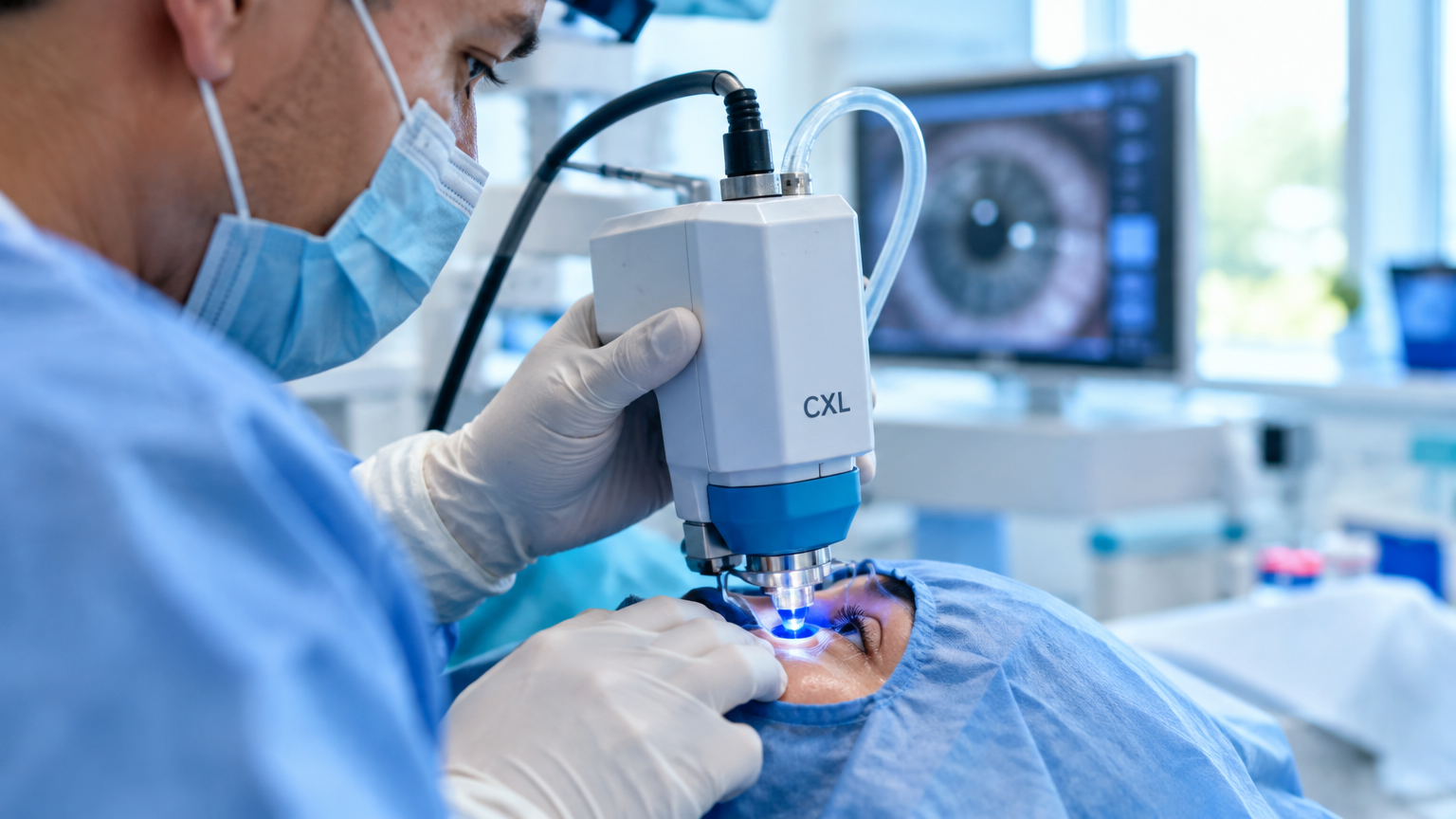
Corneal cross-linking Dubai is a minimally invasive procedure that halts the progression of keratoconus and corneal ectasia by strengthening the cornea’s collagen fibres. If you have progressive keratoconus or worry about vision loss, this treatment can stabilize your cornea and prevent the need for corneal transplantation.
Who Qualifies for Cross-Linking?
According to global consensus, CXL addresses keratoconus or ectasia when there is definitive progression. This includes measurable increases in maximum keratometry (Kmax), steeper corneal curvatures, worsening astigmatism, loss of corrected vision, or thinning of the cornea. Pediatric patients under 18 are often treated earlier due to higher progression risk.
Age and Disease Stage
- Late teens through early 30s: the typical active disease phase. Many patients develop keratoconus in adolescence, with progression often slowing after the mid-30s. CXL is more urgent in younger patients with severe disease.
- In older patients with slow progression, corneal stabilization without intervention may be acceptable, though close monitoring remains essential.
Corneal Thickness Requirements
- Standard epithelium-off CXL typically requires a minimum stromal thickness of approximately 400 µm to protect the inner corneal layers and endothelium.
- For corneas thinner than 400 µm, modified methods exist: hypoosmolar riboflavin, specialized “sub-400” protocols, or certain epithelium-on techniques. These require extra caution for safety.
Other Eligibility Factors
- Bilateral disease or steep K readings greater than 55 diopters signal more aggressive disease.
- Good general ocular health with no active infection or severe scarring. Patients must avoid contact lens use before imaging and commit to rigorous follow-up.
- Patients who have had LASIK, PRK, or other refractive surgery need evaluation for post-LASIK ectasia. If ectasia is occurring, CXL can be preventive or therapeutic.
Epithelium-Off vs. Epithelium-On Protocols
| Feature | Epithelium-Off (Standard) | Epithelium-On (Transepithelial) |
|---|---|---|
| Epithelium removal | Entire central epithelium removed (8–9 mm) | Epithelium left intact or partially disrupted |
| Riboflavin penetration | Better absorption into stroma | More barrier; slower, more complex delivery (iontophoresis) |
| UV exposure time | Usually 30 minutes (standard); accelerated forms available | Shorter or varied, depending on method |
| Pain and discomfort | Significant pain; higher risk of haze and infection; slower healing | Less pain early on; lower complication risk with mild disease |
| Long-term effectiveness | Stronger, more consistent flattening and stabilization of cornea | Comparable in mild-to-moderate cases; faster recovery but potentially less effective for high-risk disease |
Am I Eligible for CXL in Dubai? A Quick Assessment
Use this guide to help assess your eligibility for corneal cross-linking Dubai:
- Age: Patients under 25 with keratoconus have higher risk and are more likely to need CXL. Over 35, disease often stabilizes, so CXL is considered only if progression continues.
- Progression evidence: Look for an increase in Kmax of 1 dioptre or more over 12 months, or 0.5 dioptre over 6 months. Also note any worsening vision, astigmatism, or decreasing corneal thickness.
- Corneal thickness: Stromal thickness of 400 µm or greater supports standard epithelium-off CXL. Thinner corneas may need specialized protocols or epithelium-on techniques.
- Disease severity and risk factors: Steep cornea (high K), family history, post-LASIK ectasia signs, strong eye rubbing, or allergies indicate higher risk.
- Post-LASIK or preventative use: After LASIK, if scans show early ectasia or thinning, CXL may be used preventively.
If you’re unsure whether your case qualifies, many clinics offer a candidacy consultation, including measurements and imaging. For example, LERC Dubai charges AED 200 for a 30-minute diagnostics consultation.
Expected Costs for Corneal Cross-Linking Dubai
| Clinic | Approximate Cost (per eye) | Details |
|---|---|---|
| LERC Dubai | From AED 6,000 | Likely for epithelium-on or basic-level treatments. Includes full diagnostics and DHA-licensed consultant. AED 200 consultation fee can be deducted. |
| Dubai Eye Clinic | AED 12,000 | Standard epithelium-off CXL package covering procedure fee, operating room, medications, and some follow-ups. Exact quote requires consultation. |
Typical price range across Dubai clinics (Healthcare City, Business Bay, Marina, JBR) is AED 6,000–15,000 per eye, depending on:
- Protocol chosen (epithelium-off is more expensive due to longer operating room time)
- Clinic reputation and surgeon experience
- Inclusion of diagnostics, follow-ups, and whether both eyes are treated
Insurance coverage may apply if your plan includes surgical or optical benefits for keratoconus management. Some providers like Daman cover stages I–III of the condition.
Recovery Timeline After Treatment
Epithelium-Off Protocol Recovery
| Time After Procedure | What to Expect |
|---|---|
| Day 0–1 | Major discomfort: pain, tearing, and light sensitivity. A bandage contact lens is applied. |
| Day 2–7 | The epithelium heals over several days with an intensive drop regimen (antibiotics, steroids, lubricants). |
| Week 1–2 | Bandage lens is removed once the surface heals; vision remains blurry or fluctuating. Avoid water contact and makeup. |
| Weeks 3–4 | Vision improves progressively; haze reduces. Some patients return to non-physical work. |
| Months 3–6 | Continued healing; topography begins to stabilize. Contact lens fitting becomes possible. |
| 12+ months | Full stabilization of corneal curvature and vision. Final results are assessed. |
Epithelium-On Protocol Recovery
- Much more comfortable in the first few days with no epithelium removal.
- Faster healing and lower risk of infection or haze.
- Drops and eye protection are still necessary.
- Vision recovery is quicker, often reaching usable levels within 1–2 weeks. However, corneal flattening and stabilization may progress more slowly or be slightly less consistent than epithelium-off methods.
Why Choose Dubai for Corneal Cross-Linking?
- Advanced clinics in Dubai Healthcare City, Business Bay, and JBR feature state-of-the-art imaging (topography, tomography) to detect progression early.
- All clinics are DHA-licensed and adhere to international standards. Providers like Novomed, Moorfields, LERC, and Dubai Eye Clinic advertise their keratoconus and CXL protocols.
- Insurance policies often require disease staging documentation and specific thickness or keratometry thresholds. Early-stage disease typically qualifies for coverage.
Frequently Asked Questions
Can I have cross-linking if my cornea is thinner than 400 µm?
Yes. Special protocols exist, such as sub-400 techniques using hypoosmolar riboflavin or modified UV exposure, to protect thin corneas. However, risks are higher, and suitability requires expert evaluation.
Will cross-linking improve my vision immediately?
No. CXL is designed to halt progression rather than reverse existing damage. Some patients see mild improvements (less distortion, better corrected visual acuity) over months. However, glasses or contact lenses are often still needed.
What are the main risks or side effects?
Epithelium-off procedures carry greater risks of pain, infection, corneal haze, and slower recovery. Epithelium-on treatments offer less early discomfort and fewer complications but may be less effective in high-risk or rapidly progressing cases.
Can I have cross-linking after LASIK?
Yes. If signs of post-LASIK ectasia or thinning develop, CXL can prevent worsening. Preventative CXL after LASIK is less common and carefully planned, often favouring epithelium-off methods in severe cases.
How will I know if I truly need cross-linking?
You need documented progression evidence: repeat imaging 6–12 months apart showing changes in Kmax, worsening vision, or thinning. A specialist will assess your scans, refraction, and symptoms during a candidacy consultation.
Take the Next Step
If you’re in Dubai and wondering whether you need corneal cross-linking, whether you’re eligible, and what it will cost, the best first step is to book a consultation at a top eye clinic. During a candidacy assessment, specialists will measure your cornea, evaluate how quickly your keratoconus is progressing, and discuss epithelium-off versus epithelium-on options tailored to your case.
Early intervention with corneal cross-linking Dubai can preserve your vision and prevent the need for more invasive procedures later. Book a free consultation at a leading Dubai eye clinic today to get personalized guidance based on real measurement data and customized treatment options.