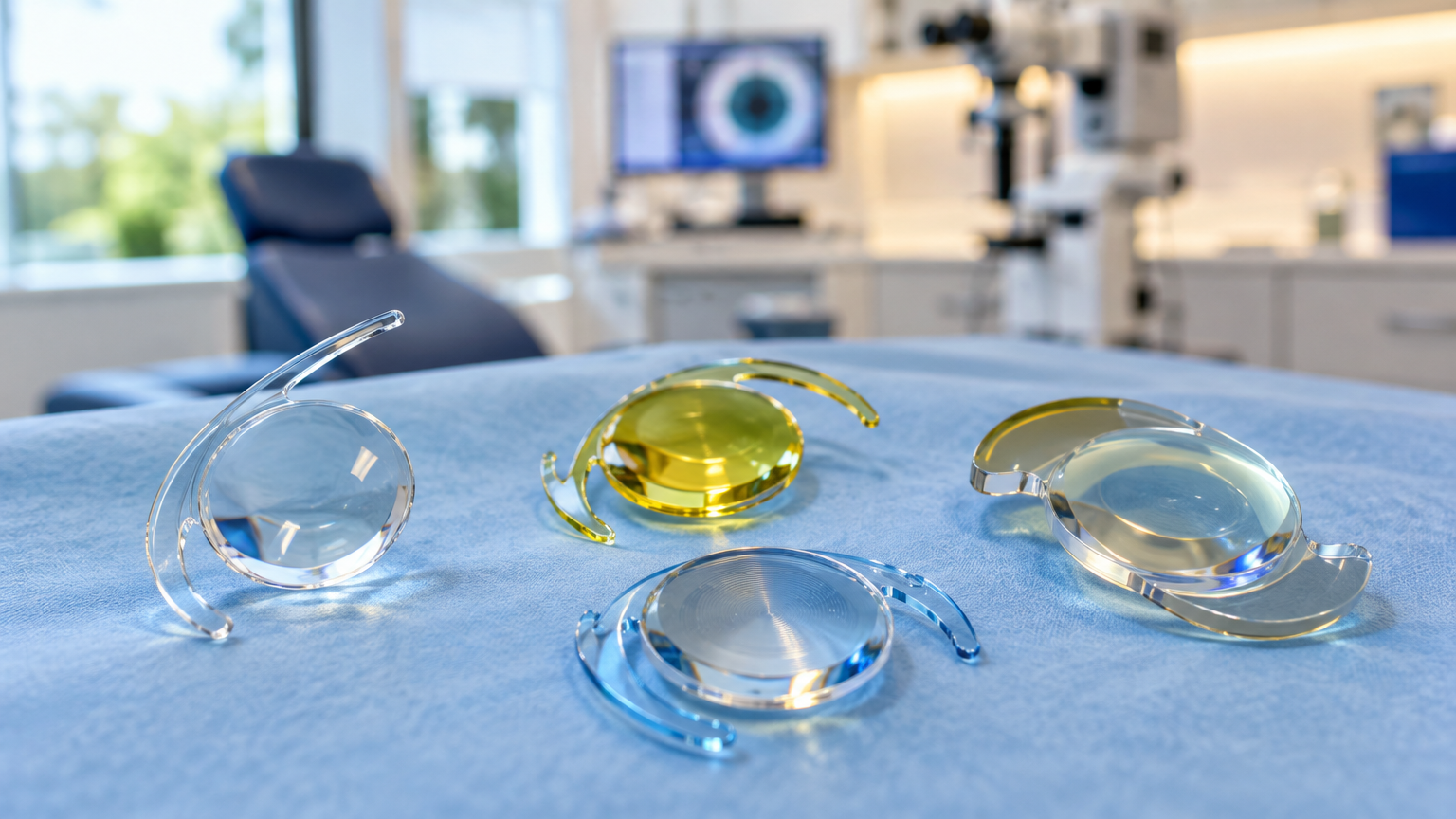
Choosing the right lens implants Dubai comparison can be overwhelming, especially if you’re 45+ and considering cataract surgery or refractive lens exchange. This guide walks you through each IOL (intraocular lens) type, real costs in AED, and which clinics offer the widest portfolios. By the end, you’ll know exactly which lens delivers the best long-term value for your lifestyle and budget.
Quick Summary
- Overview of lens implant types (monofocal, toric, multifocal, EDOF) and what each delivers for driving, reading, screens, and night vision.
- Cost comparison in Dubai, showing how premiums increase with advanced lens options.
- What to look for: DHA-licensed clinics, surgeon experience, and verified IOL brands.
- Top clinics in Dubai offering the widest IOL portfolios and transparent pricing.
- Which lens type offers best long-term value for those over 45, based on lifestyle and total cost.
What Is an Intraocular Lens (IOL)?
When your natural lens becomes cloudy (cataract) or you choose to exchange it for vision correction (refractive lens exchange), an IOL replaces it permanently. Your choice of lens type determines how well you see at all distances—far, near, intermediate (screens)—and how your eyes perform in low light.
The Main IOL Types Explained
| Lens Type | Vision Without Glasses | Best For / Trade-Offs |
|---|---|---|
| Monofocal | One distance (usually far) | Sharp driving and outdoor vision. Near reading still needs glasses. Lowest risk of halos or glare. (aao.org) |
| Enhanced Monofocal | Distance + improved intermediate | Better for screens and dashboards. Still requires reading glasses. Moderate cost increase. (drfouadelsayyad.com) |
| Toric (monofocal or premium) | Corrects astigmatism plus distance | Essential if your cornea is irregular. Improves clarity, especially for night driving. Adds cost. (aao.org) |
| EDOF (Extended Depth of Focus) | Strong distance + good intermediate; functional near | Ideal for computer work and digital device use. Some reading may still need glasses. Fewer halos than multifocal. (drfouadelsayyad.com) |
| Multifocal / Trifocal | Near, intermediate, and far all clear | Best for reducing glasses dependence completely. Trade-offs include higher cost, more glare and halos, reduced contrast at night. (drhc.ae) |
| Accommodative / Light-Adjustable | Changes focus dynamically or custom-tuned after surgery | Closest to natural eye behavior. More expensive and complex. Available at fewer clinics. (drfouadelsayyad.com) |
Lens Performance for Daily Activities
Driving (Day and Night)
Monofocal or toric-monofocal lenses give the sharpest clarity and best contrast. Premium multifocal or trifocal options can cause halos around bright lights, especially at night. If night driving is frequent, distance-optimized lenses perform best.
Reading and Near Work
Multifocal or trifocal lenses offer the best glasses-free reading. Some people also benefit from “monovision”—optimizing one eye for near vision and the other for distance. Monofocal lenses require reading glasses for close work.
Screens and Intermediate Tasks
EDOF and enhanced monofocal lenses excel here. Multifocal lenses can work, but may reduce smooth focus transitions between distances.
Long-Term Durability
All modern IOLs last a lifetime. Your main concern is eye health conditions like macular degeneration, glaucoma, or previous eye surgeries—these can limit how well premium lenses perform. Monofocal lenses work reliably in almost all cases. (drhc.ae)
Lens Implants Dubai Comparison: 2026 Pricing in AED
Here’s what you’ll pay per eye at private hospitals and clinics in Dubai. Prices include surgery and the implant itself.
| Lens Package | Clinic Type | Cost (per eye) AED | Additional Notes |
|---|---|---|---|
| Monofocal Standard | Basic or mid-range clinic | ~14,000 AED | Most affordable option |
| Toric Monofocal | Mid-range clinics | 16,000–20,000 AED | Corrects astigmatism; varies by brand and complexity |
| EDOF | Premium clinics | 18,000–22,000 AED | Good middle ground between monofocal and multifocal |
| Multifocal / Trifocal | Top clinics (Clemenceau, Mediclinic, Moorfields) | 18,000–24,000 AED | Premium option; highest cost but best glasses-free vision |
Optional add-ons (femtosecond-assisted surgery, advanced imaging, surgeon experience) can increase costs further. Standard monofocals are more likely covered by insurance; premium lenses often require out-of-pocket payment. Always ask your clinic what insurance covers. (mediclinic.ae)
Top DHA-Licensed Clinics with Wide IOL Portfolios
Choose a Dubai Health Authority (DHA) licensed facility with broad lens options, experienced surgeons, and clear cost breakdowns. Here are the leading clinics:
Moorfields Eye Hospital UAE
Location: Dubai Healthcare City (DHC)
Offers monofocal, multifocal, toric, and EDOF lenses. Surgeons like Dr. Osama Giledi and Dr. Salman Waqar bring extensive experience. Strong reputation for refractive lens exchange. (moorfields.ae)
Mediclinic Middle East
Location: Multiple locations (Deira, City, and others)
Offers regular and premium IOLs, including multifocal and toric options. Publishes separate package pricing for standard versus multifocal lenses. Femtosecond-assisted surgery available at select locations. (mediclinic.ae)
Clemenceau Medical Center (CMC)
Location: Business Bay
Specializes in premium IOL options including multifocal, toric, and combined lens types. Comprehensive cataract surgery packages with premium options range from AED 20,000–24,000. (cmcdubai.ae)
DRHC (Dr Rami Hamed Center)
Location: Dubai Healthcare City and Majan
Offers EDOF, multifocal, and toric lenses. Mid-range premium costs (roughly AED 14,000–18,000 for monofocal versus multifocal options). (drhc.ae)
All are DHA licensed. Verify licenses through the Dubai Medical Registry (Sheryan). (dha.gov.ae)
Finding Best Long-Term Value for Your Needs
Start With Your Lifestyle
Do you drive long distances at night? Then monofocal or toric-monofocal lenses offer the sharpest contrast and least glare. Spend most time on screens or reading? EDOF or premium multifocal may deliver better convenience.
Consider Your Eye Health
Existing macular degeneration, glaucoma, or corneal disease can limit how well premium lenses perform. In these cases, standard monofocal is the safer choice. If astigmatism is present, add a toric option to improve distance clarity and sharpness.
Weigh Total Cost Against Glasses Expenses
Premium lenses cost AED 4,000–10,000 more per eye now. However, you’ll spend less on reading glasses, computer glasses, and other eyewear over 10–20 years. Quality reading glasses in Dubai cost several hundred to over one thousand AED every few years. Over a decade, a premium lens investment may pay for itself in convenience and saved accessories.
Choose a Clinic With Options and Transparency
Work with a clinic like Moorfields, Mediclinic, CMC, or DRHC that offers multiple lens choices and clear pricing. Meet your surgeon before committing. Ask about brands they use, surgical technology (femtosecond-assisted, image-guided alignment for toric), and post-operative care quality.
Frequently Asked Questions
Are premium lenses worth it at age 45–55?
It depends on your priorities. Premium lenses reduce dependence on glasses for near, intermediate, and distance vision. But they cost more upfront and carry trade-offs: potential halos, glare, and adaptation time. If reading and near tasks are frequent and glasses-free vision matters to you, they may be worth the extra cost. Otherwise, enhanced monofocal or EDOF often deliver most benefits with fewer compromises. (aao.org)
Will insurance cover premium IOLs in Dubai?
Standard monofocal cataract surgery is more likely partially or fully covered. Premium, trifocal, and EDOF lenses are typically viewed as elective upgrades and require out-of-pocket payment. Read your policy carefully and ask each clinic what portion they cover. (mediclinic.ae)
Which lens type works best for reading fine print?
Multifocal or trifocal lenses offer the sharpest near vision. EDOF can help, but not as sharply for detailed close work. Some people benefit from monovision (one eye optimized for near, one for distance), though this requires adaptation. (drfouadelsayyad.com)
How do premium lenses affect night driving?
Premium lenses often cause more glare or halos around lights, especially in low-contrast conditions like nighttime driving. Monofocal lenses preserve contrast best in dim light. If night driving is important, many surgeons recommend monofocal (possibly toric) for your dominant eye. If you choose premium lenses, accept some trade-offs in night vision. (aao.org)
How long before premium lenses “pay for themselves”?
This depends on your annual eyewear spending. Quality reading glasses or prescription computer glasses in Dubai can cost hundreds to over one thousand AED every few years. Over 10–15 years, the extra AED 4,000–10,000 per eye for a premium lens may be justified if you use near tasks daily. For casual near use, the financial benefit is less clear.
The Best Long-Term Value: Final Recommendation
For most expats and retirees in Dubai over 45, the best value lies in one of these options:
- Best “sweet spot”: Toric monofocal or EDOF + toric. This gives excellent distance vision and intermediate (screen) performance with minimal glare and strong night vision.
- Budget-conscious choice: Standard monofocal at a reputable DHA-licensed clinic. Delivers excellent lifetime vision with minimal risk and lowest upfront cost.
- Maximum convenience: Premium multifocal only if you have healthy eyes, stable prescription, frequent screen and reading use, and don’t mind higher cost and adaptation time.
Ready to Explore Your Options?
Book a free consultation at a top eye clinic in Dubai to compare options for your specific needs. Bring your current prescription and recent eye scans so the surgeon can map which lens types work best for you and provide exact cost-benefit analysis.
When you schedule, ask these three questions:
- Which IOL types and brands does your clinic have available?
- What are