Quick Summary
- Learn the key eligibility criteria for LASIK Dubai eligibility so you can self-assess before booking a consultation
- Understand pre-screening tests clinics use — corneal topography, wavefront analysis, pachymetry — and what they reveal
- Discover conditions that disqualify you from LASIK, such as keratoconus or autoimmune disease, and explore alternatives like SMILE, PRK, and ICL
- Review typical costs in AED to help you budget for LASIK and alternative procedures
- Use our checklist to guide your decision before booking a free consultation at a Dubai eye clinic
What Is LASIK Eligibility: An Overview
Before exploring LASIK pricing in Dubai, you need to know whether you qualify. Many people discover they’re ineligible only after paying for assessments. Your LASIK Dubai eligibility depends on several measurable factors: corneal thickness, prescription strength, age, dry eye status, and pupil size.
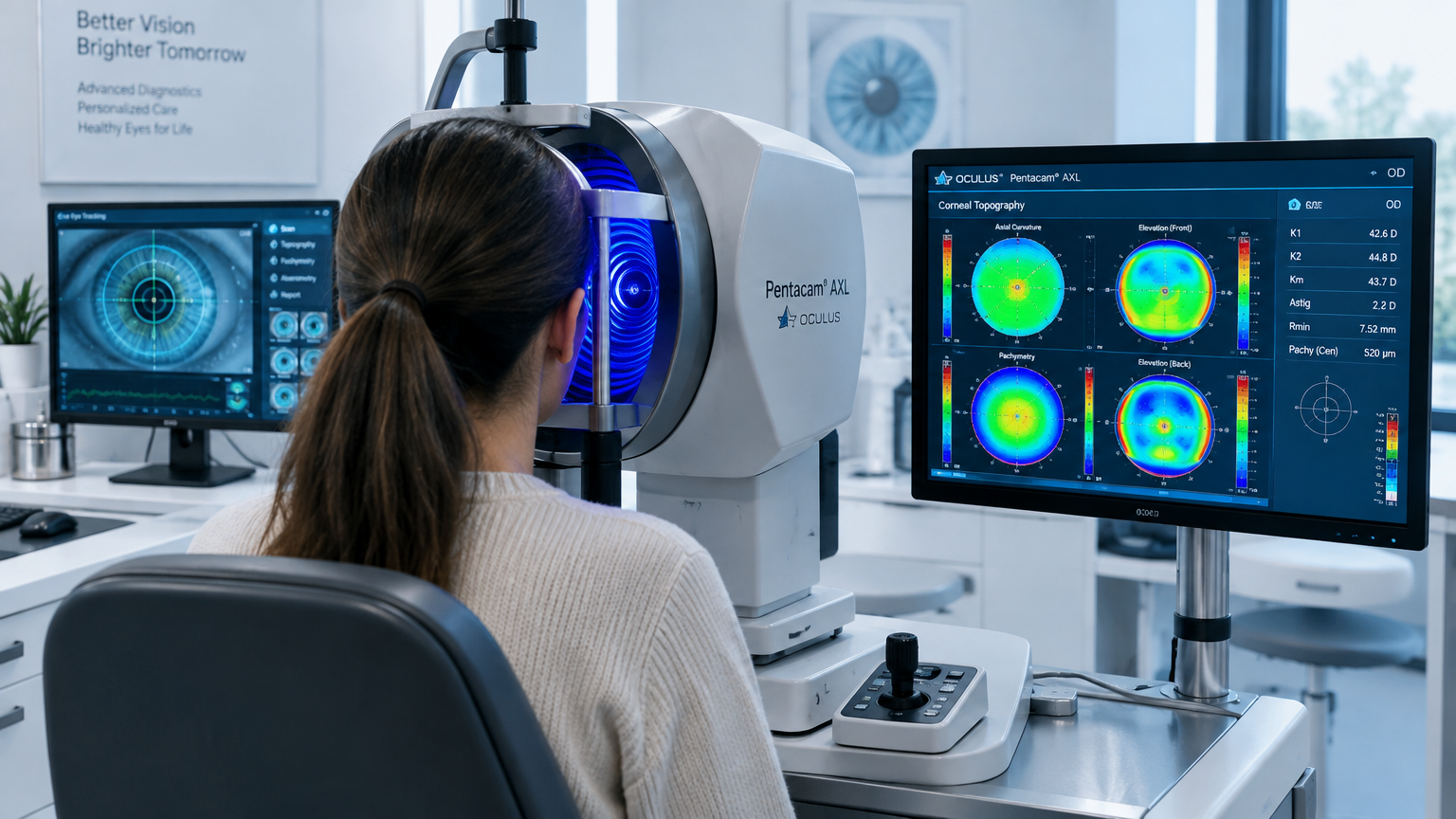
Dubai clinics use advanced pre-screening tests to map your eyes in detail. These include corneal topography, pachymetry, and wavefront analysis. If your results fall outside safe ranges, surgeons recommend alternatives like SMILE, PRK, or ICL instead.
Key Eligibility Factors for LASIK Dubai
Dubai refractive eye clinics evaluate several criteria to determine who can safely undergo LASIK:
| Eligibility Factor | Typical Acceptable Range | Why It Matters |
|---|---|---|
| Age | Minimum 18 years; prescription stable for at least 1 year; ideally under 40–45 before presbyopia develops | Younger eyes are still developing. Older eyes may experience presbyopia or slower healing. |
| Prescription (Refractive Error) | Mild to moderate myopia (−1 D to −8 D typical); hyperopia and astigmatism within certain limits | LASIK reshapes the cornea. Very high prescriptions may require removing too much tissue. |
| Corneal Thickness | Central corneal thickness (CCT) usually ≥500 µm; adequate residual stromal bed needed after flap formation | Insufficient tissue after surgery increases the risk of corneal weakening (ectasia). |
| Pupil Size | Dark-room pupil size <6–7 mm; larger pupils increase risk of glare and halos | A large pupil relative to the optical zone can cause visual side-effects, especially at night. |
| Dry Eye History | Mild or well-controlled dry eye acceptable; moderate to severe dry eye may disqualify or steer toward SMILE or surface lasers | LASIK cuts corneal nerves. Dryness can worsen significantly post-surgery. |
Pre-Screening Tests at Dubai Clinics
Before LASIK, you’ll undergo several diagnostic tests. These evaluations help surgeons confirm your eligibility and plan your procedure.
Corneal Topography & Pachymetry
Corneal topography creates a detailed map of your cornea’s shape. It detects irregularities like keratoconus or asymmetrical curvature that would disqualify you from LASIK.
Pachymetry measures corneal thickness precisely. Since the flap requires some tissue, clinicians need to confirm enough tissue remains after reshaping.
Wavefront Analysis
This test maps higher-order aberrations such as spherical aberration and coma. It helps predict potential night vision issues or halos. Wavefront-guided LASIK uses this data to customize your treatment.
Other Key Tests
- Schirmer test or tear-film assessment for dry eye evaluation
- Pupil measurement under dim lighting (pupillometry)
- Complete medical history review, including autoimmune conditions and pregnancy status
- Confirmation that your prescription has remained stable for at least 12 months
Conditions That Disqualify LASIK
Certain medical conditions make LASIK unsafe. If you have any of these, your surgeon will recommend alternatives.
Common Disqualifying Conditions
- Keratoconus or suspected keratoconus — The cornea thins and bulges abnormally. LASIK flaps worsen this condition.
- Autoimmune diseases — Lupus, rheumatoid arthritis, and Sjögren’s syndrome increase inflammation and slow healing.
- Pregnancy or breastfeeding — Hormonal changes shift refractive error and affect healing.
- Unstable refractive error — Prescription changes exceeding 0.5 D in the past year contraindicate surgery.
- Severe, uncontrolled dry eye disease — Post-LASIK dryness can become severe.
Alternative Procedures for Disqualified Candidates
If LASIK isn’t suitable, several options exist:
- SMILE (Small Incision Lenticule Extraction) — This flap-free procedure involves fewer corneal nerves. It causes less dry eye and preserves better biomechanics. SMILE works well for moderate myopia.
- PRK / TransPRK — A surface laser procedure with no flap. Healing takes longer, but it suits thin corneas well.
- ICL (Implantable Collamer Lens) — A lens inserted inside the eye without reshaping the cornea. This option suits high corrections and thin corneas.
Typical Costs in Dubai
Understanding procedure costs helps you make realistic budget decisions. Prices vary by technique, clinic reputation, and location.
| Procedure | Cost per Eye | Typical Cost for Both Eyes |
|---|---|---|
| Standard LASIK | AED 3,000–AED 5,500 | AED 6,000–AED 11,000 |
| Femto-LASIK | AED 4,000–AED 7,000 | AED 9,000–AED 14,000+ |
| SMILE / SMILE Pro | AED 6,000–AED 10,000 | AED 12,000–AED 20,000+ |
| ICL (Phakic Lens) | AED 10,000–AED 18,000 | AED 20,000–AED 35,000+ |
| Pre-Operative Assessment | AED 200–AED 800 (sometimes included) | Varies by clinic |
Many clinics bundle pre-operative assessments into their total package. Always confirm what your quote includes: both eyes, assessments, follow-ups, and potential enhancement procedures.
What to Look for in a Dubai LASIK Clinic
Choosing the right clinic makes a significant difference. Evaluate these factors:
- Technology — Do they use topography-guided lasers, wavefront analysis, and femtosecond lasers?
- Surgeon credentials — Board-certified ophthalmologist specialized in refractive surgery with proven experience and good patient reviews.
- Clinic accreditation — DHA-licensed facility with proper oversight and hospital-standard safety protocols.
- Pricing transparency — The quote should clearly state what’s included: both eyes, assessments, follow-up visits, and potential enhancements.
- Post-operative support — A clear follow-up schedule, accessible aftercare, and complication management protocols.
Self-Assessment Checklist
Use this checklist before booking a paid consultation. If you answer “no” to more than two questions, discuss alternative procedures with your clinic.
| Question | Response |
|---|---|
| I’m at least 18, and my prescription hasn’t changed more than 0.5 D in the last year. | Yes / No / Unsure |
| My refractive error is within moderate range (not extremely high). | Yes / No / Unsure |
| My corneas are thick enough (≥500 µm); I have no thinning disease. | Yes / No / Unsure |
| I don’t have serious dry eyes; any dryness is well-controlled. | Yes / No / Unsure |
| My pupil size under low light is normal (<6–7 mm). | Yes / No / Unsure |
| I’m not pregnant, breastfeeding, or diagnosed with autoimmune disorders. | Yes / No / Unsure |
If most answers are yes, you’re likely a good candidate for LASIK. Even if some are no, alternatives like SMILE, PRK, or ICL may still work for you.
Frequently Asked Questions
Can I have LASIK if my corneas are thin?
Thin corneas (under 500 microns) increase LASIK risk because the flap and reshaping remove tissue. Dubai clinics often recommend PRK, SMILE, or ICL for thin corneas since these preserve or avoid corneal tissue removal.
What prescription ranges are safe for LASIK?
Most Dubai clinics accept up to −8 D of myopia and moderate hyperopia or astigmatism. Higher prescriptions increase risk. ICL is often better for high corrections.
Does mild dry eye disqualify me?
Mild dry eye can be managed with drops. Moderate to severe dry eye, especially if scarring has occurred, may disqualify you from LASIK. SMILE or surface lasers like PRK are safer choices in such cases.
Is there an upper age limit for LASIK?
No strict age cut-off exists, but effectiveness drops after age 45 due to presbyopia. Over age 50, lens-based corrections often work better than corneal reshaping.
How does wavefront analysis help predict night vision problems?
Wavefront mapping identifies irregularities like coma and spherical aberration that cause halos and glare, especially under low light. Clinics use this data to customize LASIK or choose procedures that reduce these risks.
Alternative Procedures: SMILE, PRK, and ICL
If LASIK isn’t right for you, these alternatives offer vision correction with different benefits:
| Procedure | Key Benefits | Best for Whom |
|---|---|---|
| SMILE | Flap-free; minimal impact on corneal nerves; faster dry eye recovery; strong for moderate myopia | Moderate myopia; active individuals; those with thin corneas but adequate lenticule removal |
| PRK / TransPRK | No flap; surface epithelium removed; longer healing; suitable for irregular corneas | Thin corneas; active dry eye; mild corneal irregularities; those accepting longer recovery |
| ICL | Implantable lens; reversible; no corneal reshaping; works for high errors | High refractive error; very thin corneas; those over 45; minimal corneal tissue change desired |
Local Regulations and Standards
Dubai’s regulatory environment protects patients through strict oversight.
- DHA Licensing — All clinics must be licensed by Dubai Health Authority. This ensures pre-operative screening standards, surgeon qualifications, and facility safety.
- Insurance Coverage — LASIK is typically elective and not covered by standard health insurance in Dubai. Check your plan before booking.
- Assessment Costs — Many clinics offer free consultations, but detailed diagnostic tests may carry a fee. Confirm whether your price quote includes pre-operative assessments, follow-ups, and potential enhancements.
Ready to Get Started?
If you’ve reviewed the checklist above and ticked most “yes” boxes, you’re likely qualified for LASIK or an alternative procedure. When selecting your clinic, don’t choose based on price alone. Instead, prioritize technology, surgeon expertise, transparency, and aftercare quality.
Book a free consultation at a top eye clinic in Dubai to receive personalized advice. Many clinics in Dubai Healthcare City, Business Bay, Jumeirah, and Downtown offer complimentary consultations. During your visit, ask about flap type, residual corneal thickness, wavefront aberration, and available alternatives. The right clinic and procedure combination make all the difference. Take your time, gather the facts, and make a confident choice for your vision.